
What is behind a dog with weak front legs?
A dog with weak front legs is one of the clinical cases that most worries owners, and with good reason: weakness of the front legs limits activities as basic as getting up from the ground, climbing steps or simply keeping the head upright while walking. Unlike rear paralysis, which is more common and better known, front weakness has a more complex differential diagnosis because it can be of cervical neurological, local orthopedic or muscular origin.
Before acting, it is essential to understand that the cause determines the treatment. A dog with front weakness due to cervical disc herniation is not the same as one with progressive muscle atrophy or a shoulder rotator cuff tear. That is why the first step should always be a veterinary evaluation. To know the most frequent causes of paralysis or loss of mobility in dogs we explain it in detail in our specific guide, and if you suspect a muscular origin, you can also read about myositis or muscle weakness in dogs.
Dogs with weak front legs can benefit from physiotherapy, orthoses, adapted ramps and front wheelchairs. Early intervention significantly improves the prognosis.
1. Accurate diagnosis: the essential starting point
None of the following solutions is effective without a previous diagnosis. The veterinarian must determine whether the weakness is of neurological origin (cervical disc herniation, Wobbler syndrome, high spinal cord injury), orthopedic (shoulder injury, rotator cuff tear, severe elbow arthritis) or muscular (myositis, disuse atrophy). Treatment changes radically depending on the cause.
Common diagnostic tests include cervical spine and shoulder joint radiography, cervical MRI in neurologic cases, and electromyography (EMG) when peripheral nerve involvement is suspected. The Merck Veterinary Manual describes in its section on limb paralysis in dogs the reference diagnostic criteria for each type of clinical presentation.
Wobbler syndrome (cervicomedullary spondyloepathy) deserves special mention: it mainly affects large breeds such as the Great Dane, Dobermann and Rottweiler, and causes progrhttp:/saddle-wheels-dogs-recommendation-veterinary/esive weakness that frequently begins in the hind limbs before progressing to the forelimbs. Early diagnosis is key to slowing progression. To find out what veterinarians say about the use of wheelchairs in these cases, we explain it in depth.
2. Pain management and medical treatment
In many cases of front weakness there is a component of cervical, shoulder or elbow pain that the dog tries to compensate by avoiding support on the affected limb. This compensation ends up generating overload in the other three legs and can trigger secondary problems in a few weeks.
Adequate analgesic control, always prescribed by the veterinarian, can significantly improve the dog’s willingness to use the limb. Nonsteroidal anti-inflammatory drugs (veterinary NSAIDs), gabapentin or pregabalin are the most commonly used drugs depending on the pain profile. In neurological cases with neuropathic component, the combination of systemic analgesia with local physiotherapy produces the best results. Never administer human analgesics to your dog without a veterinary prescription: some, such as ibuprofen or paracetamol, are toxic to dogs even in low doses.
3. Veterinary physiotherapy and rehabilitation
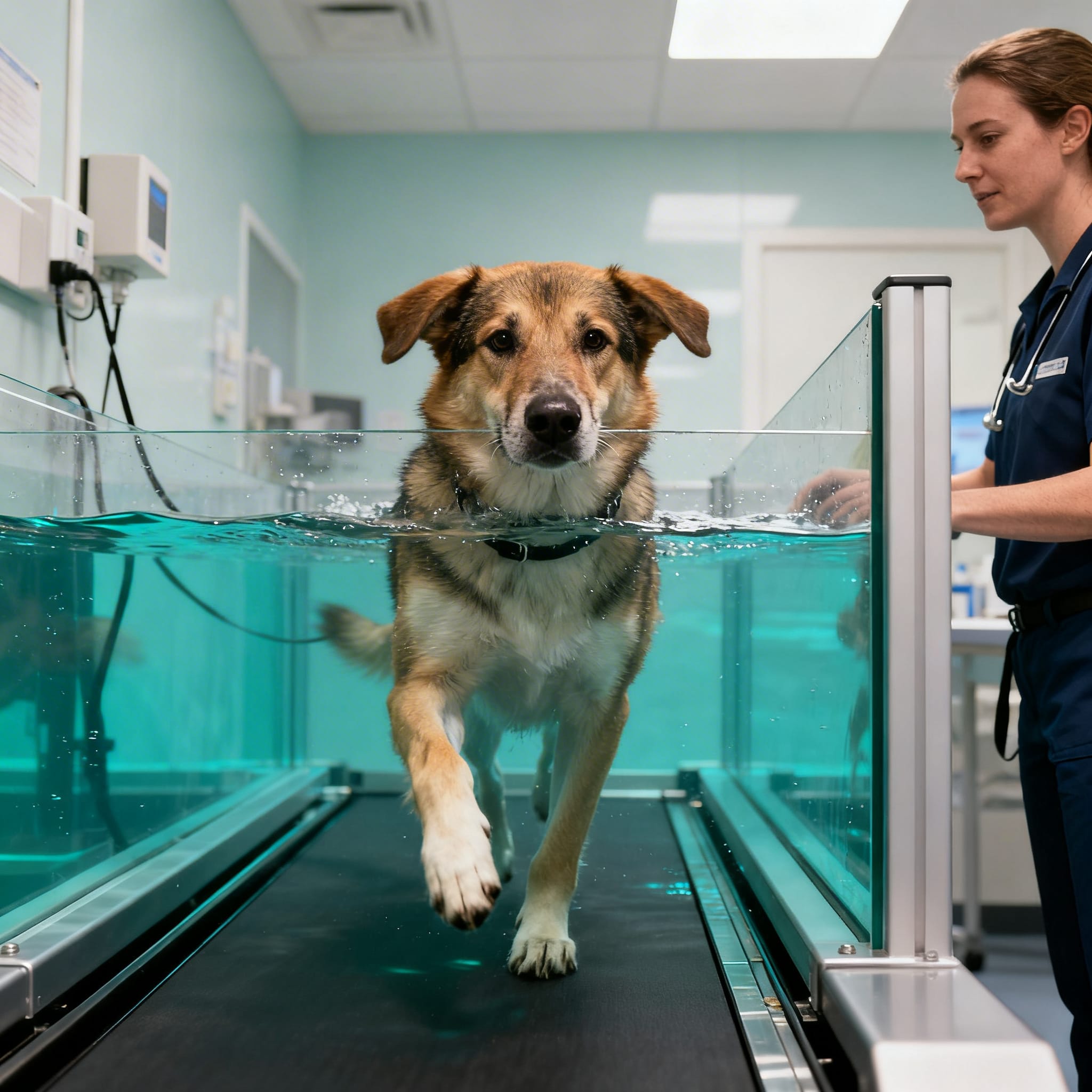
Veterinary rehabilitation is the mainstay of conservative treatment in the dog with weak front legs. A good physiotherapy program not only works on muscle strength: it also re-educates the nervous system, improves proprioception and reduces chronic pain associated with postural compensations.
Hydrokinetic therapy or water treadmill is the most commonly used technique in front weakness. Water reduces the load on the joints by up to 60-80% depending on the level of immersion, allowing the dog to perform active movements that would be impossible when dry. In addition, the resistance of the water works the musculature progressively without the risk of overloading the joints involved.
Muscle electrostimulation (NMES/TENS) is especially useful when the dog does not voluntarily use the affected limb, because it prevents muscle atrophy due to disuse. The muscle contracts in a controlled manner even if the animal does not activate it voluntarily, maintaining trophism and facilitating neurological recovery.
Proprioceptive exercises – balance platforms, uneven surfaces, cavaletti and weight bearing exercises on four supports – re-educate the peripheral and central nervous system to re-process limb position information correctly. They are especially important in neurological causes where the nerve is functioning but the signal is distorted to the brain.
4. Proprioceptive corrector and support splints
When the front weakness manifests itself as a lack of control in the placement of the paw – the dog rests on the back of the foot instead of the pad, or bends the carpus abnormally – orthopedic support devices are the most indicated solution before reaching the wheelchair.
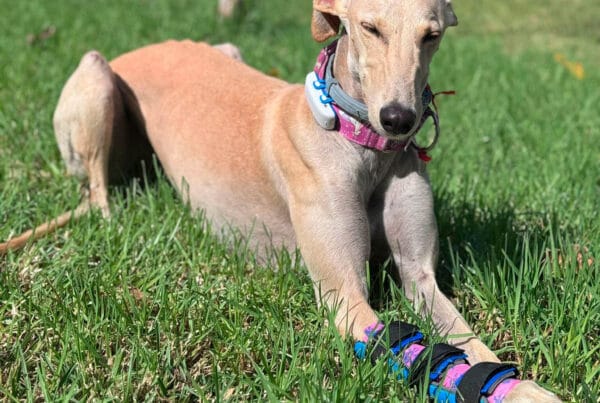
The proprioceptive corrector for dogs is a lightweight device that is placed on the foreleg and applies a tactile stimulus to the back of the foot each time the dog supports it incorrectly. This stimulus activates the proprioceptive reflex and helps the nervous system relearn the correct support pattern. It is especially useful in cases of knuckling (support on the dorsum of the paw) due to mild neurological causes or in the recovery phase.
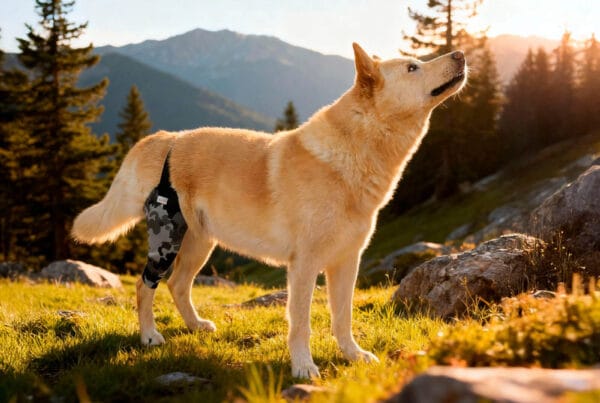
When the weakness is centered at the carpus, the carpal splint provides external stabilization of the joint, preventing hyperextension and allowing the dog to support weight bearing without risk of joint collapse. For more proximal weaknesses affecting the entire forearm or elbow, the foreleg splint provides the structural support necessary for the dog to maintain the limb in a functional position during movement.
The choice between brace and splint depends on the type and location of the weakness: the brace acts on the nervous system, the splint acts on the joint mechanics. In many cases they are used in a complementary way during the rehabilitation phase.
”The key with a dog with weak front legs is not to look for the most advanced solution right away, but the most appropriate for the stage the animal is in. Corrector, brace or saddle: each device has its moment.
5. Adaptations in the domestic environment
The home can easily become a risk factor for a dog with weak front legs. Smooth floors, steps and flush feeders are the three main everyday obstacles that increase the strain on compromised limbs and raise the risk of falls.
Flooring is the most urgent change: non-slip mats on the dog’s usual routes drastically reduce the stabilization effort he has to make with each step. A dog with front weakness on smooth tile or parquet flooring consumes extra energy with each stride just to keep from slipping, which accelerates muscle fatigue and worsens the progression of weakness.
Ramps should be substituted for steps whenever possible. The incline of the step requires active shoulder extension which can be especially painful in dogs with cervical or shoulder pathology. A low incline ramp (maximum 20-25 degrees) distributes the stress much more evenly.
The elevated feeder and drinker at the dog’s chest level prevents the dog from having to flex its neck to eat and drink. In dogs with cervical disc herniation or Wobbler’s syndrome, this repeated flexion can aggravate spinal cord compression and increase pain. An elevated feeder is one of the least expensive and most impactful adaptations to daily quality of life.
6. Front wheelchair: the solution when the weakness is severe.
When the front weakness is severe, progressive or permanent, and the previous solutions are no longer sufficient to guarantee the animal’s autonomous mobility, a front wheelchair offers the dog the possibility to move independently.
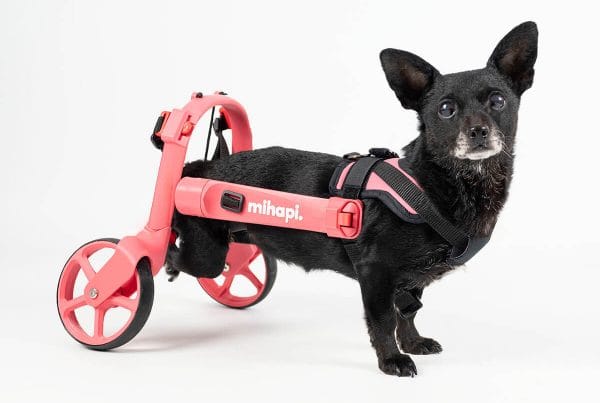
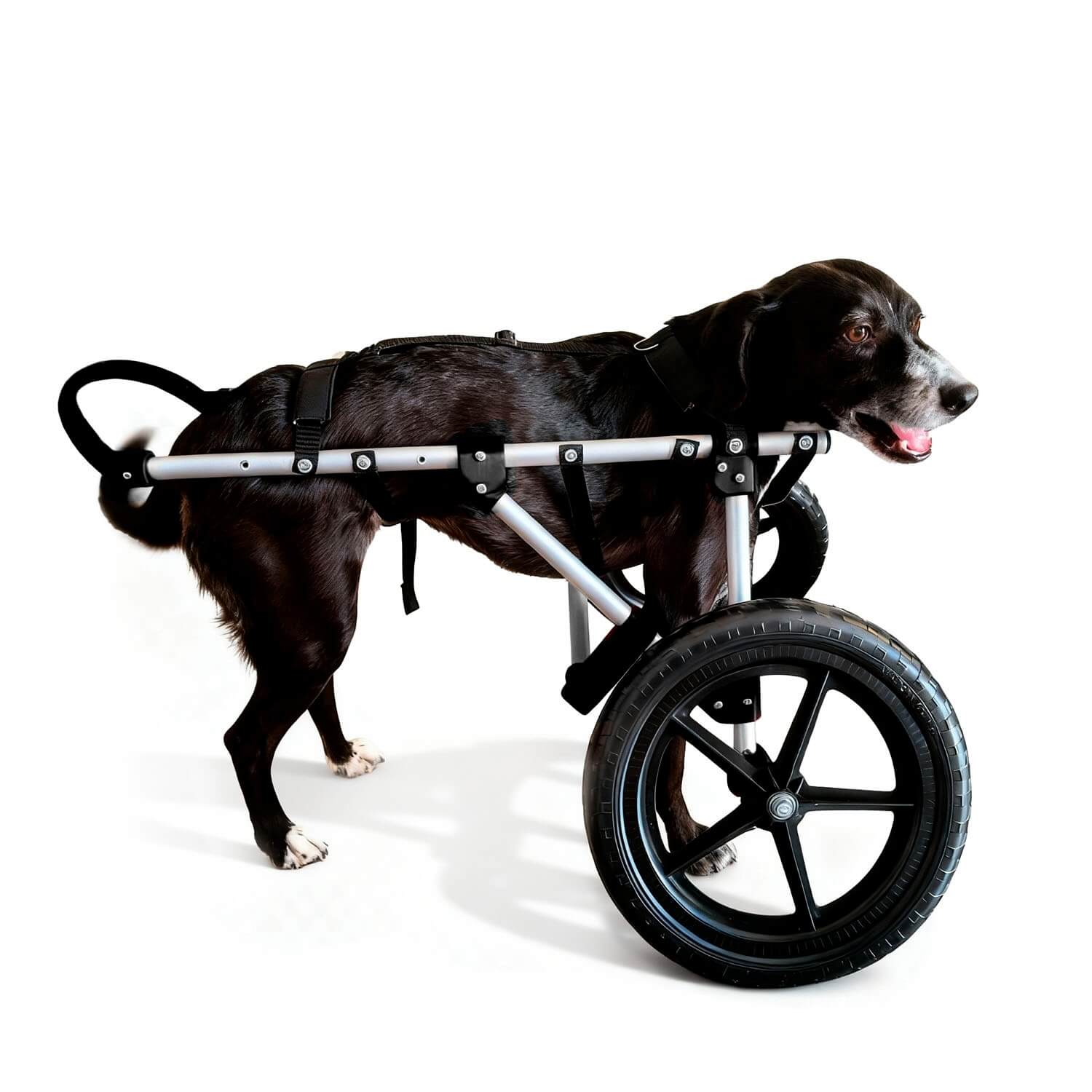
The front saddle supports the weight of the forelimbs by means of an adjustable chest arch and places two wheels under the forelimb, so that the hind legs (if functional) are the ones that propel the animal forward. The dog goes from dragging its forelimb to being able to move fluidly, which has a huge impact on both its physical well-being and emotional state.
This device is especially indicated in cases of advanced Wobbler syndrome, permanent cervical paralysis and some chronic neurological conditions with no expectation of full recovery. The AKC lists in its guide on mobility devices for dogs the clinical criteria that determine when the front chair is the most indicated option.
The Mihapi front wheelchair adjusts at multiple points to fit the exact morphology of the dog, and can be combined with the front wheelchair harness for greater stability and comfort during use. Once the dog has the chair, we tell you all about its adaptation and daily routine in our guide on how to take care of your dog with a wheelchair.
Frequently asked questions about dogs with weak front legs
Can a dog with front leg weakness recover?
It depends entirely on the cause. In weaknesses of orthopedic origin with adequate treatment (surgery, physiotherapy, anti-inflammatory drugs), recovery can be total or very significant. In progressive neurological causes such as degenerative myelopathy or advanced Wobbler syndrome, the goal is to slow progression and maintain quality of life, not complete recovery. The prognosis should always be established by the veterinary specialist after evaluating the specific case.
At what age does front weakness usually appear in dogs?
There is no single age. Neurological causes such as cervical disc herniation are more frequent in adult dogs between 3 and 8 years of age in chondrodystrophic breeds (Dachshund, Bulldog). Wobbler syndrome typically appears in large breeds from 3-4 years of age. Orthopedic causes such as shoulder or elbow arthritis are more frequent in dogs older than 7-8 years. Myositis can occur at any age.
What is the difference between frontal weakness and ataxia?
Weakness (paresis) implies reduced muscle strength: the dog tries to move the limb but cannot do so normally. Ataxia implies lack of coordination: the dog has strength but does not control the trajectory of movement well. In practice they can coexist, especially in neurological causes affecting both motor and proprioceptive pathways. The veterinarian will differentiate between the two by neurological examination.
Can a proprioceptive corrector be used in conjunction with physical therapy?
Yes, and in fact it is the most common combination in the active rehabilitation phase. The proprioceptive corrector is used during walks and daily activities to stimulate the nervous system in the real context of movement, while physiotherapy works on strength, coordination and pain in a controlled environment. Both approaches are complementary and mutually reinforcing.
When should I consider a front wheelchair for my dog?
When the weakness is so severe that the dog cannot support itself or move autonomously with the previous supports, and when conservative solutions (physiotherapy, corrective, splint) are no longer sufficient to maintain functional mobility. The decision must be taken together with the veterinarian, assessing the diagnosis, prognosis and quality of life of the animal. At Mihapi we analyze each case in a personalized way before recommending a model.
Conclusion: from physiotherapy to the chair, always with veterinary backing
Helping a dog with weak front legs is not a one-time decision: it is a process that evolves with the animal. Always start with the diagnosis, continue with medical treatment and physiotherapy, introduce orthopedic devices at the right time and, if the situation requires it, take the step towards the front wheelchair with the confidence that your dog can continue to lead a full and active life.
If you have doubts about which device is the most suitable for the stage your dog is in, Mihapi will help you to guide your decision. See front wheelchair for dogs →