
How much does a dog wheelchair cost: what you need to know before you buy
Knowing how much a dog wheelchair costs is one of the first questions any owner asks when the veterinarian mentions this option for the first time. And it makes perfect sense: it is an investment that can range from €40 to €700, and the difference between one extreme and the other is not arbitrary. The price directly reflects the quality of the materials, the precision of the fit and, ultimately, the well-being of the animal.
In this article we break down the three price ranges in the Spanish market, explain what factors determine the final cost and help you evaluate what level of investment makes sense for your dog’s specific case. A veterinarian-supported chair is not a superfluous expense: it is a clinical device with a direct impact on the animal’s recovery and quality of life.

Three price ranges in the Spanish market
Imported economy wheelchairs: 40 – 100 €.
They are the most accessible segment of the market and also the most heterogeneous in terms of quality. Generally manufactured in Asia with lightweight low-alloy aluminum and standard fabric harnesses, they offer a very limited number of adjustment points. The result is that they rarely adapt well to atypical morphologies: a Dachshund, a Basset Hound or any dog with off-average proportions will have difficulty finding a correct fit in this range.
They can be a reasonable option for dogs in a temporary recovery process that only need the device for weeks, as long as the morphology of the animal is standard and the use is supervised. They are not recommended for prolonged use, for large breed dogs or for animals with pathologies that require a very precise adjustment of the harness.
Mid-range wheelchairs: 150 – 350 €.
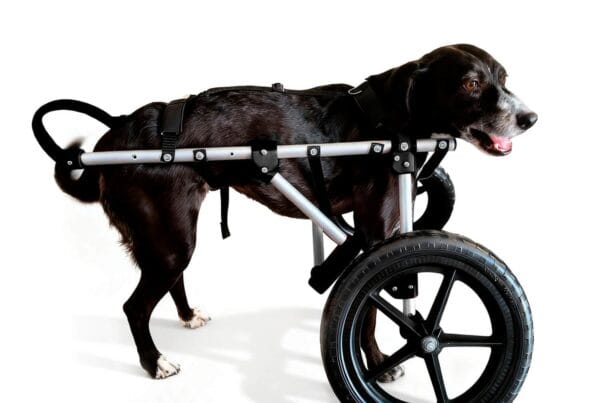
This is the most balanced segment of the market and the one that covers the majority of common use cases. Chairs in this range are made of aircraft aluminum or stainless steel, materials that are significantly lighter and stronger than standard aluminum. The harness is usually ergonomic, with higher density padding at critical pressure points.
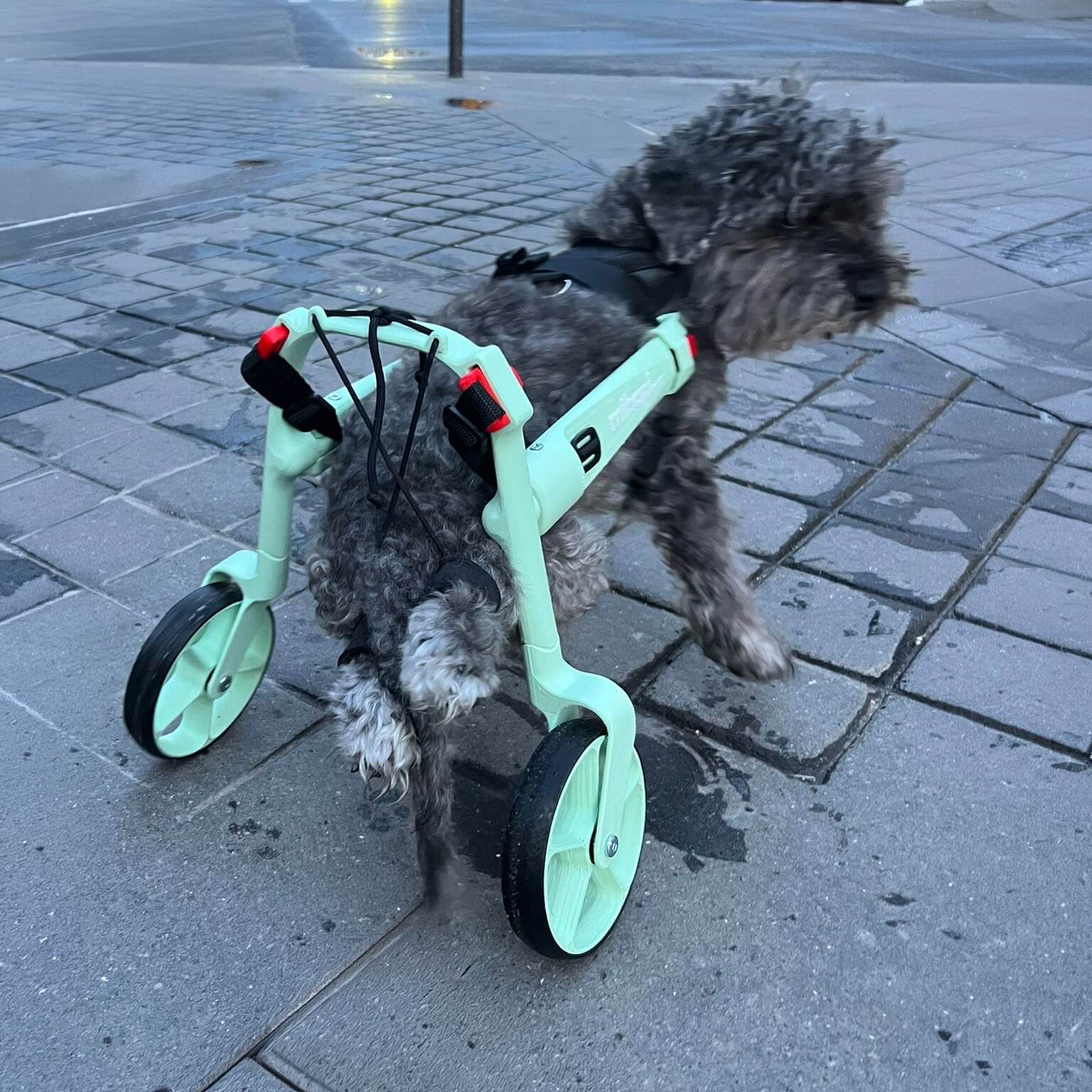
An important differentiating feature of this range is the greater number of adjustment points: frame height, side-to-side width, harness position and wheel angle are independently adjustable. This makes it possible to adapt the chair to different morphologies without the need for customized manufacturing. Here you will find both Spanish and European models of proven quality. The Mihapi wheelchair for small dogs, from 249 €, belongs to this range and is manufactured entirely in Spain.
Custom or specialized wheelchairs: 350 – 700 €.
The premium segment is reserved for two main profiles: dogs with morphologies outside the standard ranges (very large dogs, breeds with extreme proportions or animals with secondary deformities that complicate the conventional fit) and owners seeking maximum customization of materials, angles and chassis configuration.
In this range, the saddles are manufactured directly from the exact measurements of the animal, ensuring the most precise fit possible. They also include customization options that are not available in the standard models: modified wheel angles for dogs with severe dysplasia, special configurations for breeds with very deep thoraxes or adaptations for dogs with partial amputations. The Mihapi front wheelchair, from 269 €, is an example of a specialized chair available in different configurations according to the morphology of the dog.
Factors that determine how much a dog wheelchair costs
Beyond the indicative price range, five specific factors explain why two similar-looking chairs can have very different prices.
The size of the dog has the greatest impact on the final cost. Chairs for larger dogs require more material, larger diameter tube sections, sturdier wheels and stronger fastening systems. A chair for a 40 kg Rottweiler costs significantly more than one for a 3 kg Chihuahua, even within the same quality range.
The type of saddle, rear or front, also influences the price. Front saddles are generally more complex to design and manufacture because the support system must be adapted to the neck and chest area, which have more morphological variability between breeds than the hip area. This translates into more adjustment points and, usually, a somewhat higher price for the same size dog. Get to know in detail the front saddle and its benefits or the rear saddle and its benefits before deciding which model you need.
Materials make a tangible difference in durability and weight. High-alloy aircraft aluminum and stainless steel are more expensive in origin but produce lighter and more durable chairs. A lighter chair means less effort for the dog to move, which translates directly into greater motivation for use and less muscle fatigue. High-density neoprene in the harness, as opposed to standard fabric, reduces the risk of chafing and better withstands moisture and frequent cleaning.
The origin of manufacture has a direct impact on price and quality of after-sales support. Chairs manufactured in Spain or Europe have higher production costs, but offer certified material warranties, local adjustment and repair capabilities, and technical support in your language. Chairs imported from Asia in the low end of the range often lack accessible technical support and parts can take weeks to arrive.
The level of customization is the ultimate differentiating factor. A standard adjustable chair has a base price. Every custom modification – specific wheel angle, custom tube length, out-of-range harness – increases the cost of production. To find out if you need a custom model, the first step is to measure it correctly and compare it to the standard sizes available.
”A 300 € chair used for 3 years has a real cost of less than 9 € per month. The price of immobility, on the other hand, is measured in quality of life.
Is it worth investing more in a quality chair?
The short answer is yes, and the reasons are very specific. A study published in Frontiers in Veterinary Science identified that the most frequent complications arising from wheelchair use in dogs – chafing, contact zone injuries, compensatory postures – are directly related to poor fit of the device, not to the use of the chair itself. A poor fit is almost always the result of a poor quality chair with few adjustment points.
An ill-fitting wheelchair or one made of poor materials can cause chafing and skin irritation in the contact areas of the harness, incorrect postures that generate cervical or lumbar compensatory tension, increased effort by the dog to move (which reduces its motivation and time of use) and frequent breakages that leave the animal without support for days or weeks. The cost of treating these complications – veterinary visits, bandages, creams, possible repurchase of the chair – usually far exceeds the price difference between a quality chair and an economical one.
Consider also the cost of long-term maintenance and care of the device. A well-maintained aircraft aluminum chair will easily last 4-5 years. A standard aluminum chair can deteriorate in less than 12 months with heavy daily use.
Frequently asked questions about how much does a dog wheelchair cost
Does the price of the chair include the harness or is it purchased separately?
It depends on the manufacturer and model. In Mihapi, the harness is included in the price of the seat and is part of the integrated restraint system. In some manufacturers, especially in the economy segment, the harness is an optional accessory that is purchased separately. Before you buy, check exactly what is included in the price so that you can make a real comparison between models.
Is there any help or subsidy to buy a wheelchair for dogs?
In Spain there is currently no specific public aid for the purchase of mobility devices for pets. Some pet insurers with rehabilitation coverage may partially include the cost if prescribed by a specialist veterinarian. Check with your insurer for the exact terms of your policy before purchasing the device.
How much does annual maintenance of a dog wheelchair cost?
A medium-high quality chair requires minimal maintenance: regular cleaning of the harness, semi-annual lubrication of the wheel axles and annual inspection of the fasteners. The estimated cost of consumables (lubricant, minor spare parts) does not usually exceed €15-20 per year. The most frequent expenses are the replacement of the harness due to wear or change of size of the dog, which in standard models is around 25-40 €.
Do dog wheelchairs come with a warranty?
Chairs manufactured in Spain and Europe are subject to the legal guarantees of the European Union for consumer products, currently two years against manufacturing defects. Chairs imported from Asia sold directly without a European distributor may not have a warranty applicable in Spain. In Mihapi all products include warranty and technical service in Spanish.
Can I rent a wheelchair for my dog instead of buying one?
The rental of wheelchairs for dogs is not widespread in Spain. Some veterinary clinics specialized in rehabilitation have loan chairs available for the first weeks of adaptation, especially in cases of temporary recovery. If your dog will need the chair in the long term, purchase is always the most economical option. For more than three months’ use, the cost of rental (when available) usually exceeds the purchase price of a mid-range model.
Can I buy the chair online or is it better to buy it in person?
Online purchasing is perfectly valid if you follow the correct measurement protocol and the manufacturer offers pre-order advice. At Mihapi we check each customer’s measurements before confirming the size and model, which eliminates the main risk of online shopping: receiving a chair that does not fit properly. See all models and prices →